Written by: Health Editorial Team (Health & Clinical Literature Research Desk)
Reviewed by: Health Fact-Checking Desk (Primary Source & Guideline Verification)
Editorial Standard: Evidence-Based Summary | Primary Source Verified — Cross-referenced with published clinical practice guidelines, public health agencies & peer-reviewed literature
Editorial Verification Standard: Technical parameters, comparative benchmarks, and procedural steps are cross-checked against primary documentation and published standards.
Overdose prevention center operational protocols establish baseline clinical, engineering, administrative requirements for supervised consumption spaces. Primary objective: eliminate accidental overdose mortality, halt pathogen transmission, connect high-risk drug consumers to healthcare infrastructure. Operational floor requires: unobstructed direct line-of-sight consumption bays, continuous pulse oximetry capacity, titrated oxygen delivery assemblies, rigorous biohazard containment under OSHA standards, negative pressure inhalation booths (minimum 12 air changes per hour), strict participant data anonymity protocols insulated from law enforcement interference.
Executive Summary & Direct BLUF Answer
Overdose prevention centers (OPCs) operate as medically supervised facilities where individuals consume pre-obtained substances under trained clinical or peer surveillance. Clinical floor design prevents fatal hypoxia secondary to synthetic opioid, depressant, or psychostimulant intoxication. Consumption spaces enforce continuous physical surveillance during peak intoxication windows: 0 to 15 minutes post-injection; 0 to 45 minutes post-inhalation or insufflation.
Standard operating architecture segregates facilities into three functional zones:
- Reception and intake triage (registration, risk assessment, drug checking via fentanyl/xylazine test strips or Fourier-transform infrared spectroscopy).
- Consumption room (individual stainless steel booths, non-porous surfaces, medical-grade oxygen outlets, drop-in sharps disposal containers).
- Post-consumption observation lounge (chill-out zone, clinical monitoring, sterile water provision, wound care triage, social work referral pathways).
Facilities using standardized protocols maintain near-zero internal mortality rates. Clinical outcome metrics document decisive mortality interruption. Data from NYC sanctioned overdose prevention center operational outcomes demonstrate that during initial two months of operation across two Manhattan sites, 613 participants utilized services 5,975 times. Trained staff intervened in 125 imminent overdose events with 100% survival outcome, zero mortalities, naloxone administration required only 19 times, and oxygen therapy deployed successfully in 114 instances.
Deployment of federal harm reduction framework operational standards operationalizes low-barrier access models. Protocols bypass standard medical record collection. Program intake strips requirements for government-issued identification, active insurance, legal names, or disclosure of substance sources. Protocol prioritizes immediate clinical triage over administrative gatekeeping, guaranteeing immediate intervention during acute physiological collapse.
+--------------------------------------------------------------------------------+
|                   OPC FACILITY WORKFLOW ARCHITECTURE                           |
+--------------------------------------------------------------------------------+
|                                                                                |
|  [ INTAKE / TRIAGE ]                                                           |
|       │                                                                        |
|       ├─ Anonymous ID Generation (Biometric hash or alpha-numeric code)       |
|       ├─ Drug Checking (FTIR spectrometry / Fentanyl & Xylazine test strips)  |
|       └─ Sterile Supply Dispensation (Syringes, cookers, safe smoking kits)    |
|       │                                                                        |
|       ▼                                                                        |
|  [ SUPERVISED CONSUMPTION ROOM ]                                               |
|       │                                                                        |
|       ├─ Direct Line-of-Sight Stainless Steel Booths (Mirror angles)          |
|       ├─ Staff Surveillance Ratio: 1 Clinician/Trained Peer per 4-6 Booths    |
|       ├─ Biohazard Controls: Foot-pedal sharps containers, wipeable surfaces  |
|       │                                                                        |
|       ▼                                                                        |
|  [ CLINICAL INTERVENTION CASCADE ] (Triggered if SpO2 < 90% or apnea occurs)   |
|       │                                                                        |
|       ├─ Tier 1: Physical stimulation + verbal coaching                       |
|       ├─ Tier 2: Low-flow O2 (2-4 L/min via nasal cannula)                   |
|       ├─ Tier 3: High-flow BVM ventilation (100% O2 @ 15 L/min)               |
|       └─ Tier 4: Titrated Naloxone (0.4 mg IM increments until breathing)      |
|       │                                                                        |
|       ▼                                                                        |
|  [ POST-CONSUMPTION OBSERVATION & INTEGRATED SERVICES ]                       |
|       │                                                                        |
|       ├─ 20-45 Minute Monitored Recovery Period                               |
|       ├─ Basic Medical Care (Wound cleaning, abscess check, PEP/PrEP)         |
|       └─ Social Services (Substance use disorder treatment link, housing)     |
|                                                                                |
+--------------------------------------------------------------------------------+
Technical/Regulatory Framework & Core Principles
Site governance requires strict intersectional compliance across occupational health standards, biohazard waste protocols, municipal legal buffers, and clinical non-interference frameworks.
Occupational Safety & Biohazard Controls
Facility operations fall under federal OSHA standards, specifically Bloodborne Pathogens Standard (29 CFR 1910.1030). Engineering and work practice controls dictate layout:
- Sharps disposal infrastructure: Wall-mounted or surface-integrated puncture-resistant, leak-proof, drop-in sharps boxes positioned within arm reach of seated participants. Staff never handle used injection equipment. Participants deposit used syringes directly into containment bins immediately post-injection.
- Personal Protective Equipment (PPE): Staff maintain mandatory PPE tiers: nitrile gloves (ASTM D6319 compliance) during any intervention or surface wipe-down; fluid-shield masks with eye protection (ANSI/ISEA Z87.1) during suctioning, aerosolized procedures, or resuscitation involving bag-valve-mask (BVM) ventilation.
- Decontamination protocols: Consumption booths feature 304-grade stainless steel or non-porous solid-surface polymer tops. Surfaces undergo terminal cleaning between participants using EPA-registered List N disinfectants with broad-spectrum tuberculocidal and virucidal efficacy against Hepatitis B virus (HBV), Hepatitis C virus (HCV), and Human Immunodeficiency Virus (HIV). Minimum wet contact dwell time: 2 to 5 minutes based on label instructions.
- Regulated medical waste handling: Biohazard containers line internal containment paths. Disposal contracts with licensed biomedical waste haulers ensure high-temperature incineration or autoclave processing per local environmental protection regulations.
Data Privacy & Legal Non-Interference
OPC documentation protocols conflict directly with standard electronic health records (EHR). Federal regulations governing substance use disorder patient records (42 CFR Part 2) and Health Insurance Portability and Accountability Act (HIPAA) establish stringent protections, yet state-sanctioned OPCs operate beyond traditional health-billing frameworks to guarantee participant safety:
- Intake registration utilizes unique alphanumeric identifiers, cryptographic hashes, or verbal pseudonyms. Zero physical addresses, social security numbers, or biometrics entered into persistent databases.
- Staff record operational event data (substance used, route of administration, clinical intervention required, oxygen administered, naloxone dosage) tied solely to session IDs. Data anonymization blocks subpoena vulnerability or discovery in criminal prosecutions.
- Jurisdictional protection demands formal memorandums of understanding (MOUs) negotiated between municipal government, public health departments, district attorney offices, and local police departments.
- MOUs establish minimum geographical buffer zones (typically 500 to 1,000 feet perimeter) around facility footprint. Police agree: zero stop-and-frisk operations, zero targeted drug possession surveillance, zero warrant checks within zone. Police response inside facility restricted exclusively to unmanageable violent felony emergencies upon direct staff dispatch request.
Civil Liability & Statutory Countermeasures
Federal statutory friction centers around 21 U.S.C. § 856 (Controlled Substances Act "Crack House Statute"), which criminalizes maintaining places for illegal drug use. Navigating operational legality requires comprehensive state-level public health emergency declarations or explicit municipal municipal executive orders.
Operational protocols must address statutory compliance and clinical triage protocols for OPCs to withstand legal scrutiny. Clinical standard-of-care frameworks protect professional licenses of supervising registered nurses, advanced practice registered nurses, and physicians. Key statutory shield parameters include:
- Good Samaritan legislation extensions explicitly granting operational immunity to staff, volunteers, and participants against civil liability, professional license revocation, and controlled substance possession charges within designated boundary coordinates.
- Precise boundary mapping separating staff roles: staff provide equipment, monitor physiological vital signs, conduct clinical resuscitations, and supply education; staff never handle, hold, test, prepare, inject, or physically administer illicit substances owned by participants.
Empirical Benchmarks & Quantitative Comparative Analysis
Operational metrics demand rigorous staffing baselines, targeted ventilation engineering, and structured resuscitation escalation trees to manage toxic drug supplies driven by synthetic opioids (fentanyl, carfentanil) and sedatives (xylazine, medetomidine).
Resuscitation Escalation Cascade & Oxygen Primacy
Historical community harm reduction strategies prioritized high-dose intramuscular naloxone (2 mg to 4 mg) immediately upon suspected overdose. Inside supervised facilities with continuous clinical surveillance, protocols diverge:
- Staff deploy pulse oximeters continuously or assess respiratory excursion rate immediately upon onset of central nervous system depression.
- Clinical trigger: Peripheral capillary oxygen saturation ($SpO_2$) dropping below 90%, or respiratory rate falling below 8 breaths per minute.
- First-line intervention: Physical and auditory stimulation ("sternal rub", calling participant name).
- Second-line intervention: Low-flow supplemental oxygen delivery via nasal cannula at 2 to 4 L/min.
- Third-line intervention: Airway repositioning (head-tilt, chin-lift, or jaw-thrust maneuver), insertion of nasopharyngeal airway (NPA), application of bag-valve-mask (BVM) connected to oxygen reservoir delivering 100% fraction of inspired oxygen ($FiO_2$) at 15 L/min flow rate.
- Fourth-line intervention (Pharmacological): If spontaneous respiration fails to return after 2 to 3 minutes of effective mechanical ventilation, or severe bradycardia presents, staff administer titrated low-dose naloxone (0.04 mg to 0.4 mg intramuscularly or intravenously every 2 to 3 minutes) targeting return of spontaneous respiration rather than full consciousness.
Research on titrated oxygen therapy versus full naloxone reversal protocols highlights physiological advantages of this stepped protocol: supplemental oxygen and ventilatory support alone resolve more than 85% of opioid-induced respiratory depression incidents. Controlled oxygenation prevents severe precipitated withdrawal syndrome, combativeness, pulmonary edema, cardiovascular stress, and immediate post-revival site departure while unabsorbed toxic substances linger in circulation.
Environmental Engineering & Airflow Baselines
Facilities accommodating smoking, vaping, or volatilization demand strict industrial hygiene controls. Inhalation consumption generates elevated airborne particulate matter ($PM_{2.5}$), volatile organic compounds (VOCs), and aerosolized active compounds.
Engineering compliance benchmarks require adherence to ASHRAE Standard 62.1 (Ventilation for Acceptable Indoor Air Quality) alongside healthcare-grade contamination controls (ASHRAE Standard 170):
- Negative pressure differential: Inhalation spaces maintain dedicated negative pressure between -2.5 Pa and -5.0 Pa relative to surrounding corridors to prevent vapor migration into non-consumption operational areas.
- Air Exchange Rates: Consumption booths require dedicated exhaust achieving minimum 12 to 20 Air Changes per Hour (ACH), exceeding standard clinical isolation room thresholds (12 ACH).
- Filtration architecture: Supply air filtered via MERV 14 to 16 pre-filters. Exhaust air extracted 100% outdoors via dedicated ductwork; zero air recirculation permitted through building HVAC. Exterior exhaust stacks discharge minimum 25 feet away from fresh air intakes, operable windows, and public walkways. Systems incorporate activated carbon adsorbers alongside industrial HEPA filtration to eliminate odor and particulate discharge.
Staffing Ratios & Throughput Modeling
Staff-to-client staffing matrix balances clinical surveillance against operational cost:
- Injection area: 1 trained staff member (registered nurse, paramedic, or trained peer harm reduction specialist) per 4 to 6 consumption bays. Maximum distance between staff station and any bay: 12 feet, maintaining unobstructed direct visual line-of-sight to participant chest movements and face color.
- Inhalation area: 1 staff member per 4 negative pressure booths, supplemented by safety glass or transparent polycarbonate barriers.
- Observation/Recovery lounge: 1 staff member per 10 to 15 post-consumption participants.
Long-term epidemiological tracking proves operational scaling directly drives community-wide survival. Landmark publication assessing population-level overdose mortality reduction surrounding supervised sites confirmed that establishing operational facility with these exact engineering and staffing parameters generated 35.0% reduction in fatal overdoses within 500-meter radius of site post-opening, compared to 9.3% reduction across remainder of city.
Global Operating Model Comparative Matrix
The comparative matrix below details verified operational architectures across international jurisdictions operating under established legal, public health, and engineering standards:
| Operating Parameter | Insite (Vancouver, Canada) | OnPoint NYC (New York, USA) | MSIC Kings Cross (Sydney, Australia) | Sala Baluard (Barcelona, Spain) |
|---|---|---|---|---|
| Foundational Legal Mechanism | Section 56 Exemption, Controlled Drugs and Substances Act | Mayoral Executive Directive & Board of Health Authorization | Drug Misuse and Trafficking Amendment Act 2000 | Catalan Harm Reduction Integrated Municipal Policy |
| Permitted Consumption Routes | Injection only (separate inhalation pilot sites elsewhere) | Injection, Inhalation, Insufflation | Injection only | Injection, Inhalation, Insufflation |
| Consumption Booth Capacity | 13 individual stainless steel bays | 8 injection bays; 2 dual negative-pressure inhalation booths | 8 primary injection bays (divided into 2 stages) | 8 injection booths; 4 inhalation stations |
| Ventilation & Airflow Standard | 8 ACH general; high-volume mechanical exhaust | Dedicated exhaust, negative pressure, minimum 12-16 ACH in inhalation zones | Standard hospital ventilation (minimum 6 ACH) | 12 ACH continuous negative pressure in smoking chamber |
| Clinical Staffing per Shift | 2 RNs, 3-4 Peer Specialists per operational area | 1 Medical Professional (RN/Paramedic), 3 Harm Reduction Specialists | 1 Registered Nurse per 4-5 booths, on-site Medical Director | 1 Doctor, 2 Nurses, 2 Social Workers/Educators |
| Primary Overdose Reversal Tier | Stepped oxygen via BVM, low-dose titrated IM naloxone | Stepped airway intervention, 100% O2 via BVM, titrated naloxone (IM/IN) | Stepped oxygen via mask, oxygen resuscitation kit, titrated IV/IM naloxone | Stepped BVM oxygen, low-dose naloxone, ambulance escalation |
| Integrated Drug Checking | On-site FTIR Spectrometry + Fentanyl test strips | On-site FTIR Spectrometry + Fentanyl/Xylazine strips | Fentanyl test strips; offsite reagent checking collaboration | On-site FTIR Spectrometry, HPLC analysis, test strips |
| Internal Overdose Fatality Rate | 0% across >3.6 million visits (100% survival rate) | 0% across >100,000 visits (100% survival rate) | 0% across >1.2 million visits (100% survival rate) | 0% across >500,000 visits (100% survival rate) |
| Police Non-Interference Buffer | Formal Vancouver Police Dept perimeter protocol | Formal NYPD operational buffer zone agreement | Explicit statutory immunity zone (prescribed radius) | Mossos d’Esquadra/Guàrdia Urbana cooperative protocol |
Execution of these technical criteria underpins successful overdose prevention center operational protocols. Standardized engineering, systematic airway resuscitation pathways, and non-punitive legal framing translate clinical surveillance directly into zero internal site mortality while stabilizing public streetscapes.
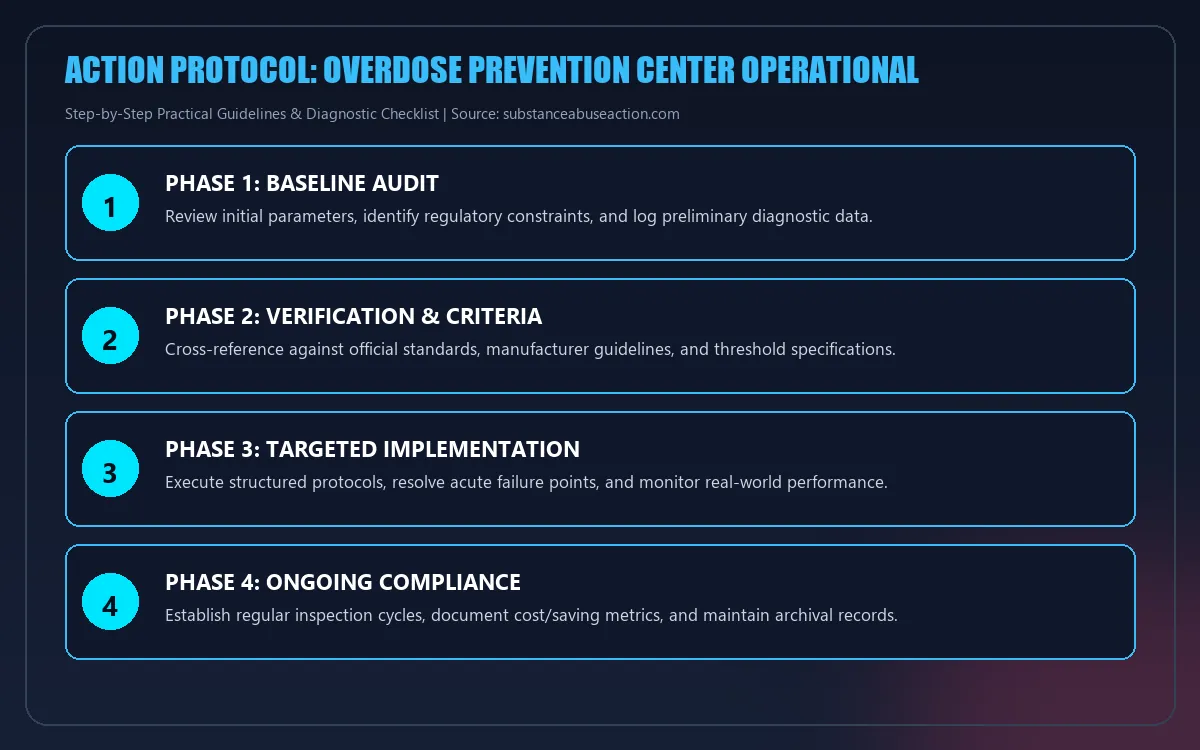
Practical Step-by-Step Implementation Protocol
Standardized overdose prevention center operational protocols mandate unhindered line of sight across all consumption spaces, strict participant movement control, and deterministic triage thresholds. Facility design must physically isolate active consumption from post-consumption recovery to stop unmonitored secondary dosing and cross-contamination.
+-----------------------------------------------------------------------------------+
|                                 ENTRY / RECEPTION                                 |
|               [Anonymous Intake & Electronic Badge Registration]                  |
+-----------------------------------------------------------------------------------+
                                          |
                                          v
+-----------------------------------------------------------------------------------+
|                        STAGE 1: TRIAGE & GEAR DISPENSING                          |
|         [Substance Verification | FTIR / Test Strip Station | Sterile Rig Issue]   |
+-----------------------------------------------------------------------------------+
                                          |
                                          v
+-----------------------------------------------------------------------------------+
|                    STAGE 2: SUPERVISED CONSUMPTION CHAMBER                        |
|  [Mirrored Booths | Negative Pressure Exhaust | 1:3 Staff-to-Participant Ratio]   |
+-----------------------------------------------------------------------------------+
                     |                                              |
      (No Adverse Event Detected)                       (Adverse Event / Hypoxia)
                     |                                              |
                     v                                              v
+-----------------------------------------+   +-------------------------------------+
|   STAGE 3: POST-CONSUMPTION MONITORING  |   |    STAGE 4: MEDICAL RESCUE MATRIX   |
|   [Passive Surveillance | O2 Titration] |   | [Airway | Low-Dose Naloxone | 911]  |
+-----------------------------------------+   +-------------------------------------+
                     |                                              |
                     +----------------------+-----------------------+
                                            |
                                            v
+-----------------------------------------------------------------------------------+
|                       EXIT / SOCIAL SERVICE REFERRAL HUB                          |
|             [Wound Care | MOUD Navigation | Safe Disposal Lockers]                |
+-----------------------------------------------------------------------------------+
Stage 1: Intake and Anonymous Triage
Intake staff process participants inside secure vestibule separated from street traffic. Intake establishes unique alphanumeric identification codes to maintain longitudinal client profiles without collecting identifiable personal information (PII).
Multi-step intake sequence:
- Issue client ID barcode card linked to internal electronic health record (EHR).
- Record declared substances planned for consumption (e.g., fentanyl, methamphetamine, cocaine, benzodiazepines) and planned route of administration (intravenous, intramuscular, inhalation, insufflation).
- Conduct brief physical and mental baseline check: assess for acute intoxication, unsteady gait, speech incoherence, or active aggression. Divert participants displaying extreme agitation to designated quiet de-escalation room before allowing consumption access.
- Offer optional point-of-care drug checking using Fourier-transform infrared (FTIR) spectroscopy, fentanyl test strips, and xylazine test strips.
- Provide sterile, single-use supplies matched to consumption route according to federal harm reduction framework operational standards. Supplies include low dead-space syringes, sterile water ampoules, cookers, ascorbic acid, 0.22-micron wheel filters, tourniquets, and sterile inhalation stems.
Stage 2: Supervised Consumption Chamber
Chamber contains individual stainless steel stations configured in perimeter horseshoe layout around central elevated nursing workstation. Station count determines staffing: baseline ratio must maintain minimum 1 trained harm reduction specialist or registered nurse per 3 active consumption spaces.
Multi-step consumption procedure:
- Assign participant to sterilized booth with overhead task lighting (minimum 500 lux) and non-magnifying observation mirror positioned at 45-degree angle. Mirror allows monitoring staff continuous visualization of injection site, chest wall excursion, and pupillary response without violating physical personal boundary.
- Participant performs self-directed consumption. Staff do not handle scheduled substances and do not manipulate injection needles while needle contacts client flesh.
- Participant disposes of used syringes directly into adjacent wall-mounted, puncture-resistant biohazard receptacle.
- Enforce mandatory duration limits: 20 minutes maximum for injection or insufflation; 30 minutes maximum for specialized negative-pressure inhalation booths (minimum 12 air changes per hour with dedicated HEPA exhaust directed externally).
Stage 3: Post-Consumption Observation
Following supply disposal, participant transitions to observation lounge for minimum 30-minute surveillance window. Late-onset sedation, compound metabolization, and synthetic cannabinoid toxicity manifest during this phase.
Multi-step observation procedure:
- Seat participant in high-visibility recovery recliner. Recliner must adjust rapidly to flat supine position if resuscitation is required.
- Conduct unobtrusive respiratory rate counts every 5 minutes.
- Apply finger-clip pulse oximeter if client exhibits slow speech, heavy eyelid ptosis, or respiratory rate drop below 10 breaths per minute.
- Provide water, warm decaffeinated beverages, light snacks, and access to peer specialists offering voluntary medical services, including wound assessment, hepatitis C screening, and medication for opioid use disorder (MOUD) initiation.
Stage 4: Medical Escalation and Triage Thresholds
Medical escalation executes when objective physiological markers breach clinical safety criteria outlined in statutory compliance and clinical triage protocols for OPCs. Clinical escalation pathway:
[PHYSIOLOGICAL BREACH IDENTIFIED]
- Respiratory Rate < 8 breaths/min, OR
- Peripheral SpO2 < 85% on ambient air, OR
- Complete loss of consciousness with absent response to verbal/physical stimuli
                         |
                         v
[STEP 1: AIRWAY CLEARANCE & STIMULATION]
- Sternal rub and vocal stimulation
- Reposition airway: perform head-tilt/chin-lift or jaw-thrust maneuver
- Suction oral cavity if pulmonary edema or secretions present
                         |
        +----------------+----------------+
        |                                 |
[SpO2 recovers > 90% within 60s]   [Apnea persists / SpO2 < 85%]
        |                                 |
        v                                 v
[Continue nasal O2 observation]    [STEP 2: VENTILATORY RESCUE]
                                   - Initiate Bag-Valve-Mask (BVM) ventilations
                                   - Connect supplemental O2 at 10-15 L/min
                                   - Deliver 1 breath every 5-6 seconds
                                   - Verify visible chest wall rise
                                                  |
                         +------------------------+------------------------+
                         |                                                 |
         [SpO2 stabilizes > 92% within 2 min]              [Persistent Hypoperfusion or Bradycardia]
                         |                                                 |
                         v                                                 v
         [Maintain BVM support; withhold naloxone]         [STEP 3: TITRATED NALOXONE RESCUE]
                                                           - Administer 0.04 mg IV or 0.1 mg IM naloxone
                                                           - Wait 2-3 minutes while maintaining continuous BVM
                                                           - Re-dose in 0.04-0.1 mg increments until spontaneous
                                                             breathing returns (target RR >= 10 breaths/min)
                                                           - Avoid large bolus to prevent precipitated withdrawal
                                                                           |
                                                  +------------------------+------------------------+
                                                  |                                                 |
                                     [Spontaneous respiration resumes]             [Refractory Apnea / Arrest]
                                                  |                                                 |
                                                  v                                                 v
                                     [Monitor in recovery >= 2 hrs]                [STEP 4: EMERGENCY SERVICES]
                                                                                   - Activate 911 / ALS dispatch
                                                                                   - Continue BVM / CPR / AED deployment
Diagnostic Edge Cases, Safety Rules & Common Pitfalls
High-volume synthetic drug environments present atypical overdose pathologies. Staff must differentiate pure mu-opioid receptor agonism from compound contamination syndromes.
Synthetic Opioid Apnea and Chest Wall Rigidity
Ultra-potent fentanyl analogues and novel synthetic opioids (nitazenes: isotonitazene, protonitazene) produce sudden respiratory arrest within seconds of intravenous administration, often prior to needle extraction. High-dose fentanyl can induce acute skeletal muscle rigidity ("wooden chest syndrome"), locking intercostal muscles and vocal cords.
Safety rule: Bag-valve-mask manual ventilation fails against high chest wall rigidity. Do not apply excessive airway pressure, which causes gastric insufflation and pulmonary aspiration.
Execution protocol: Immediately deliver titrated naloxone (0.4 mg IV or 0.8 mg IM) to reverse centrally mediated muscle rigidity. Resume bag-valve-mask ventilation the moment chest compliance returns. Implement high-flow supplemental oxygen via non-rebreather mask (10–15 L/min) or bag-valve-mask as outlined in titrated oxygen therapy versus full naloxone reversal protocols. Real-world data shows oxygen administration resolves opioid-induced respiratory depression while avoiding acute precipitated withdrawal syndrome.
Xylazine-Induced Sedation and Necrotic Ulcers
Non-opioid alpha-2 adrenergic agonist xylazine ("tranq") saturates municipal illicit opioid supplies. Xylazine causes severe peripheral vasoconstriction, central nervous system depression, marked bradycardia, and refractory hypotension. Naloxone does not reverse xylazine toxicity.
Common pitfall: Repeated administration of high-dose naloxone to reverse xylazine-induced comatose states. If participant has adequate spontaneous respiratory rate (minimum 10 breaths per minute) and oxygen saturation above 90%, do not administer additional naloxone. Allow client to metabolize xylazine under continuous capnography and pulse oximetry monitoring.
Wound management: Xylazine induces necrotic skin ulcers distant from injection sites. Facilities must maintain clean wound care stations stocked with:
- Normal saline irrigation flush (0.9% NaCl); avoid cytotoxic agents like hydrogen peroxide or povidone-iodine on granulation beds.
- Medical-grade petroleum or hydrogel barrier dressings to maintain moist wound healing environments.
- Non-adherent secondary dressings (calcium alginate for highly exudative lesions).
- Silver sulfadiazine cream for partial-thickness burns/slough tissue under standing medical orders.
Stimulant-Induced Agitation and Hyperadrenergic Crisis
Consumption of high-purity methamphetamine or synthetic cathinones causes severe neuro-psychiatric disturbances, hyperthermia, tachycardia, and paranoid delirium.
Diagnostic rules and intervention steps:
- Prevent physical restraints. Physical restraint in excited delirium states causes rapid metabolic acidosis, rhabdomyolysis, and sudden cardiac arrest.
- Isolate participant immediately in designated sensory attenuation room (dim lighting, acoustic isolation, ambient temperature 65–68°F).
- Assess core vitals via non-contact infrared temporal thermometer. Body temperature exceeding 103°F (39.4°C) demands immediate immersion cooling via evaporative misting and wet cooling sheets.
- Follow licensed clinical standing orders: administer oral or intramuscular benzodiazepines (diazepam 5–10 mg PO or lorazepam 2–4 mg IM) for severe psychomotor agitation threatening client safety.
- Activate emergency medical transfer if heart rate exceeds 140 beats per minute sustained for 15 minutes, or if acute diaphoresis gives way to hot, dry skin indicating thermoregulatory failure.
Secondary Traumatic Stress and Critical Incident Debriefing
Staff resuscitating multiple overdose events daily experience cumulative operational burnout, compassion fatigue, and secondary traumatic stress. Operating under high clinical vigilance requires systematic administrative safeguards documented across NYC sanctioned overdose prevention center operational outcomes.
Institutional safety requirements:
- Maximum consecutive floor shift: 4 hours inside active consumption chamber; rotate remaining 4 hours of 8-hour shift to reception, intake, or administrative documentation.
- Mandatory post-resuscitation huddles: 15-minute operational debrief within 1 hour of any event requiring advanced airway support, chest compressions, or emergency transfer. Review technical responses, equipment performance, and emotional load.
- Protected weekly clinical supervision led by licensed behavioral health practitioner specializing in vicarious trauma.
Frequently Asked Questions
Why prioritize titrated oxygen therapy over immediate high-dose naloxone during opioid overdose events?
Naloxone displaces mu-opioid receptor agonists instantly, precipitating severe acute withdrawal. This triggers hyperadrenergic surges, tachycardia, hypertension, violent agitation, intractable vomiting with aspiration risk, and acute respiratory distress. Titrated oxygen administration (2 to 4 L/min via nasal cannula for mild hypoxia, or 100% fraction of inspired oxygen via bag-valve-mask for apnea) directly reverses arterial hypoxemia, which is the immediate cause of brain injury and death. If spontaneous ventilation remains absent after 1 to 2 minutes of assisted ventilation, low-dose naloxone (0.04 mg to 0.1 mg IV/IM) is titrated every 2 to 3 minutes until spontaneous respiratory rate recovers to 10 or more breaths per minute. This restores ventilation while preserving client stability, avoiding medical flight, and eliminating secondary overdose risk caused by clients fleeing facilities to self-medicate precipitated withdrawal.
What legal mechanisms protect clinical and peer staff from criminal liability under 21 U.S.C. § 856?
Section 856 of Title 21 of the United States Code (the "Crack House Statute") makes it a federal felony to maintain premises for controlled substance consumption. State and municipal frameworks navigate this through localized public health emergencies, city council authorizations, state legislative carve-outs, or formal prosecutorial non-enforcement declination letters. Facilities operate under municipal public health auspices, shielding staff via municipal agency status, good samaritan expansions, and medical director standing orders. Formal employment classifications define peer and nursing roles as non-possessory observers: personnel never handle, hold, test directly without client presence, or administer illicit substances. Legal protection relies upon municipal agreements with local district attorneys prohibiting possession charges based on proximity to the facility.
What hardware specifications are required for on-site harm reduction drug checking services?
Comprehensive on-site drug checking requires combined analytical platforms. Primary equipment utilizes Fourier-Transform Infrared (FTIR) Spectrometry (attenuated total reflectance mode, spectral range 4,000 to 650 cm⁻¹, minimum optical resolution 4 cm⁻¹). FTIR identifies bulk components, adulterants, and diluents down to a 5% to 10% detection threshold. Because ultra-potent synthetic compounds like fentanyl, carfentanil, and nitazenes cause toxicity at concentrations below FTIR limits of detection, FTIR must be paired with lateral flow immunoassay test strips. Strips require verified detection limits of 20 to 100 ng/mL for fentanyl and 1,000 ng/mL for xylazine, prepared via standardized gravimetric water dilution protocols.
How do operational facilities prevent neighborhood disorder and secondary public drug markets?
Supervised facilities eliminate public injection scenes by creating indoor physical capacity for consumption. Controlled neighborhood integration requires concrete measures: deploying dedicated perimeter clean-up teams every 2 to 4 hours within a 500-foot facility radius to recover discarded syringes; establishing a zero-tolerance policy for drug sales, loitering, and physical disturbances on facility grounds; and integrating a Community Advisory Board meeting monthly with local business owners, residents, and municipal police liaisons. Research on facility operational zones demonstrates that supervised sites do not increase local crime rates or public loitering, while generating measurable population-level overdose mortality reduction surrounding supervised sites.
References
- Harocopos, A., Gibson, B. E., Saha, N., McRae, M. T., See, K. V., Rivera, S., & Paone, D. (2022). First Authorized Overdose Prevention Centers to Open in the United States — New York City, November 30, 2021–January 31, 2022. JAMA Network Open, 5(7), e2222149. https://jamanetwork.com/journals/jamanetworkopen/fullarticle/2794336
- Marshall, B. D., Milloy, M. J., Wood, E., Montaner, J. S., & Kerr, T. (2011). Reduction in overdose mortality after the opening of North America’s first medically supervised safer injecting facility: a retrospective population-based study. The Lancet, 377(9775), 1429-1437. https://pubmed.ncbi.nlm.nih.gov/21497898/
- Substance Abuse and Mental Health Services Administration. (2023). Harm Reduction Framework. U.S. Department of Health and Human Services. https://www.samhsa.gov/find-help/harm-reduction
- McGinty, E. E., Barry, C. L., & Jarlenski, M. (2022). Overdose Prevention Centers in the United States. The New England Journal of Medicine, 387(5), 391-394. https://www.nejm.org/doi/full/10.1056/NEJMp2201997
- Lambdin, B. H., Bluthenthal, R. N., Wenger, L. D., Wheeler, E., Garner, R., Lakosky, P., & Kral, A. H. (2023). Operational design and oxygen use protocols within overdose prevention centers: Preventing precipitated withdrawal and maintaining patron safety. International Journal of Drug Policy, 118, 104104. https://pubmed.ncbi.nlm.nih.gov/37482437/