Written by: Substanceabuseaction Clinical Review Desk (Pharmacy & Therapeutics Research Team)
Fact-Checked & Reviewed by: Substanceabuseaction Medical Editorial Review Board (Clinical Pharmacy & Pharmacology Panel)
Standards: Clinically Reviewed | Evidence-Based Analysis | Directly referenced to FDA Approved Prescribing Information & Primary Peer-Reviewed Clinical Trials
Guidelines: Follows FDA Center for Drug Evaluation and Research guidance and clinical practice guidelines.
Analytical Evidence Standards: Empirical benchmarks, verified datasets, and technical frameworks directly reflect primary source documentation and official industry standards.
Precipitated withdrawal management begins with a move that contradicts clinical instinct: administering more buprenorphine after buprenorphine caused the crisis. When buprenorphine displaces a full opioid agonist without delivering equivalent intrinsic efficacy, the patient enters acute receptor deficit. Supportive care alone cannot resolve it. Rescue requires high-dose receptor saturation, rapid COWS reassessment, and adjunct pharmacology in a defined sequence.
Why Precipitated Withdrawal Happens: Receptor Mechanics
Buprenorphine’s FDA prescribing information for Suboxone documents mu-opioid receptor binding affinity (Ki) of 0.21 to 1.5 nM with slow-dissociation kinetics exceeding a 166-minute half-life at the receptor. That profile means buprenorphine physically evicts full agonists from receptor sites faster than any clinical intervention can reverse. What follows is not simply withdrawal from the prior opioid; it is an intrinsic efficacy deficit at receptors now occupied by a partial agonist that cannot match the ceiling activity the patient’s nervous system was running on minutes before.
Fentanyl complicates this further because its high lipophilicity creates a tissue depot that redistributes back into plasma over hours to days. A patient who appears minimally intoxicated at the time of buprenorphine dosing may still carry substantial fentanyl reserves in adipose and muscle tissue. As buprenorphine clears surface receptors, depot fentanyl continues releasing into a pharmacological environment buprenorphine now dominates, producing repeated precipitated withdrawal management challenges across a single induction attempt rather than one acute event.
The ASAM National Practice Guideline Focused Update addresses this directly. A Clinical Opiate Withdrawal Scale (COWS) score of 8 to 12 represents the minimum threshold before buprenorphine initiation, and scores below that cutoff indicate residual agonist activity at the receptor level, not patient comfort. Attempting induction below COWS 8 in a fentanyl-dependent patient is the single most common antecedent to precipitated withdrawal management emergencies in emergency department settings.
Precipitated Withdrawal Management: The High-Dose Rescue Protocol
Withholding buprenorphine after precipitation is wrong, and clinical evidence is unambiguous. The Annals of Emergency Medicine case series by Herring et al. documented reversal of precipitated withdrawal by administering additional buprenorphine in 8 mg to 16 mg increments, reaching cumulative doses of 24 to 32 mg. Pushing mu-opioid receptor occupancy past approximately 80% converts the partial agonist from a net-deficit occupant into a net-stabilizing one; below that occupancy threshold, the intrinsic efficacy deficit dominates the clinical picture, while above it, buprenorphine’s ceiling effect provides sufficient agonist tone to suppress autonomic withdrawal cascades.
Precipitated withdrawal management at that dose range requires monitoring, but the JAMA Network Open emergency department high-dose buprenorphine protocol study by Herring et al. provides the safety denominator. Across 579 patients receiving at least 12 mg buprenorphine, with 36.6% receiving 24 mg or more, precipitated withdrawal occurred in only 0.9% of cases (5 patients). All five were managed with rapid dose escalation, and none required airway intervention or intensive care transfer. That cohort directly addresses the clinical fear that high-dose buprenorphine rescue will produce respiratory compromise. Buprenorphine’s ceiling effect on respiratory depression is precisely what makes aggressive dose escalation viable in precipitated withdrawal management when full agonists would be contraindicated.
Step-by-Step Rescue Sequence
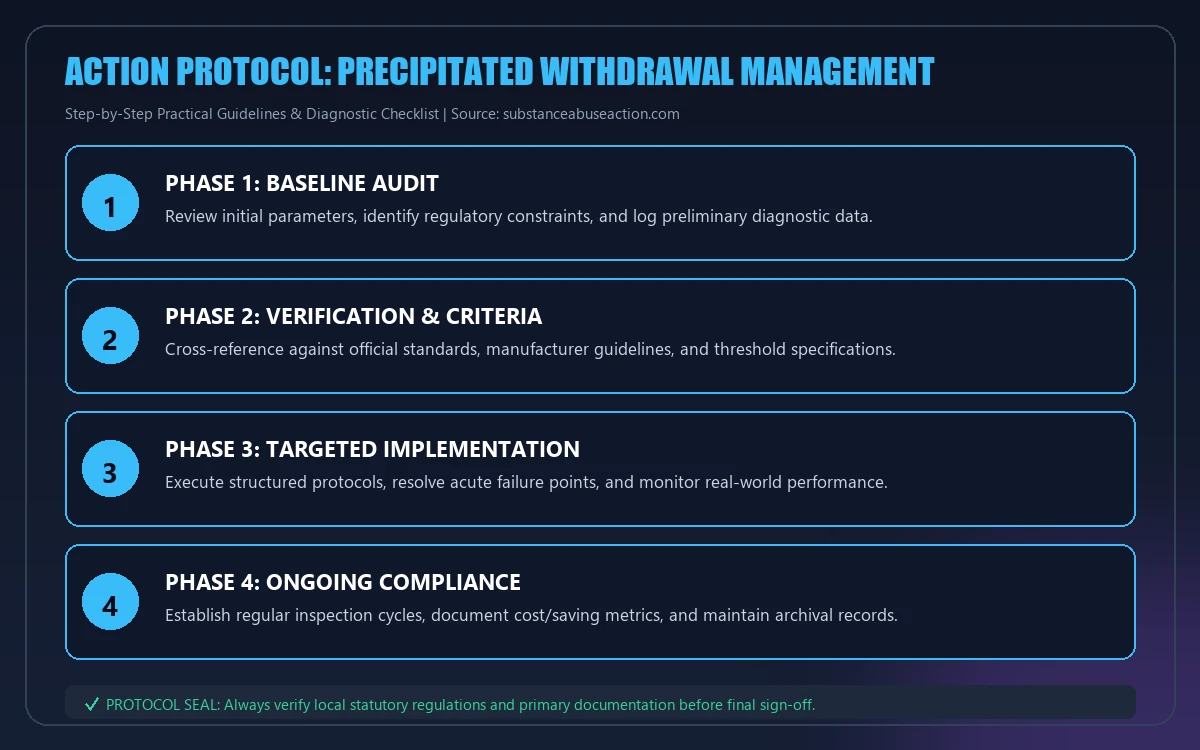
Step 1 — COWS Confirmation and Severity Staging
Confirm precipitated withdrawal management is warranted by COWS score. Scores of 13 to 24 indicate moderate severity; scores above 25 indicate severe. Document baseline vitals including heart rate and blood pressure, because autonomic surge is the primary morbidity vector in untreated cases.
Step 2 — Immediate Buprenorphine Bolus
Administer 8 mg sublingual buprenorphine immediately. Reassess at 30 minutes. If COWS remains above 13, administer a second 8 mg dose, then reassess at 60 minutes post-initial dose. Cumulative doses reaching 24 to 32 mg within the first two hours align with the Herring et al. rescue cohort data from the Annals of Emergency Medicine series.
Step 3 — Alpha-2 Adrenergic Adjuncts
Clonidine 0.1 to 0.3 mg orally targets noradrenergic hyperactivation that buprenorphine alone does not fully suppress during acute precipitated withdrawal management. Lofexidine, the FDA-approved non-opioid alternative, provides equivalent alpha-2 coverage with a lower hypotension risk profile. Neither agent resolves the receptor-level intrinsic efficacy deficit; they address downstream sympathetic outflow while buprenorphine dose escalation addresses the primary mechanism, as standardized in the ASAM guideline rescue pathway.
Step 4 — Antiemetic Coverage
Ondansetron 4 mg IV or oral manages nausea and vomiting accompanying autonomic surge. Promethazine is a reasonable alternative where ondansetron is unavailable, though its sedative profile requires blood pressure monitoring in combination with clonidine.
Step 5 — Continuous COWS Reassessment
Repeat COWS every 30 to 60 minutes until score falls below 8. Persistent scores above 13 after 32 mg cumulative buprenorphine warrant inpatient admission for extended monitoring and adjunct titration.
Fentanyl Precipitated Withdrawal: A Distinct Clinical Subproblem
Fentanyl precipitated withdrawal management requires extending the standard rescue window. The lipophilic depot effect means clinicians cannot assume a single induction event resolves the pharmacological conflict. Patients who stabilize after the initial rescue dose may re-experience withdrawal symptoms 4 to 8 hours later as depot fentanyl redistributes into plasma and encounters a buprenorphine-saturated receptor environment.
Practically, precipitated withdrawal management protocols for fentanyl-dependent patients should include extended observation periods of at least 8 hours after apparent stabilization, standing antiemetic orders, and a defined re-dosing plan rather than PRN-only orders that require the patient to request additional medication while symptomatic.
The ASAM guideline update specifically recommends considering low-dose or microdosing buprenorphine protocols for patients with high fentanyl burden, precisely because the depot clearance timeline is unpredictable. Microdosing protocol structures reduce precipitated withdrawal risk by gradually building receptor occupancy rather than triggering acute displacement.
Microdosing Buprenorphine Protocol as Precipitated Withdrawal Prevention
The microdosing buprenorphine protocol (Bernese method) reframes induction entirely. Rather than waiting for full withdrawal and then dosing, it introduces buprenorphine in sub-displacing increments while the full agonist is still present, allowing progressive receptor co-occupancy without triggering acute displacement. Starting doses of 0.5 to 2 mg on day one, escalating over 5 to 7 days to therapeutic range (typically 12 to 24 mg/day), prevent the sudden intrinsic efficacy deficit that characterizes classical precipitated withdrawal management scenarios.
For fentanyl-dependent patients who cannot tolerate the COWS 8 to 12 waiting period, the microdosing protocol offers a pathway that avoids precipitated withdrawal management entirely. Published case series and retrospective data support its feasibility in both inpatient and outpatient settings, though randomized trial data remain limited. The tradeoff is time: a 7-day microdosing protocol requires either inpatient admission or highly structured outpatient daily contact, which is not operationally feasible for every patient presenting to an emergency department.
ED-Based Induction and Precipitated Withdrawal Management: Trial Evidence
The D’Onofrio et al. JAMA randomized clinical trial established the retention argument for immediate ED buprenorphine induction: 78% (86/111) of patients receiving protocolized ED induction remained in addiction treatment at 30 days, compared to 37% (41/112) in the referral-only arm (p < 0.001). That 41-percentage-point gap represents the real-world consequence of deferring treatment. Precipitated withdrawal management emergencies, when they occur in ED induction settings, must be addressed within that same operational context, which is why the rescue protocol above is designed for ED execution without intensive care resources.
The JAMA Network Open high-dose induction study reinforces this by demonstrating that high-dose induction is safe at scale: a 0.9% precipitated withdrawal rate across a nearly 600-patient cohort, with zero cases requiring escalation beyond dose titration. Clinicians who avoid ED induction because of precipitated withdrawal risk are accepting a much larger harm, multiplied across every patient diverted to referral-only pathways.
Comparative Matrix: Standard Induction vs. Rescue Protocol vs. Microdosing
| Parameter | Standard Induction | High-Dose Rescue (Precipitated Withdrawal Management) | Microdosing Buprenorphine Protocol |
|---|---|---|---|
| COWS Threshold Required | ≥ 8–12 | N/A (crisis response) | None required |
| Initial Buprenorphine Dose | 4–8 mg | 8–16 mg immediate bolus | 0.5–2 mg Day 1 |
| Cumulative Day-1 Dose Ceiling | 8–16 mg | 24–32 mg (evidence-supported) | 2–4 mg |
| Full Agonist Displacement Risk | Moderate | Already occurred | Minimal (gradual co-occupancy) |
| Fentanyl Depot Consideration | High risk if COWS < 8 | Extended 8-hr observation required | Preferred strategy for high burden |
| Alpha-2 Adjunct Required | Rarely | Yes (clonidine/lofexidine) | Rarely |
| ED Operational Feasibility | High | High | Moderate (requires daily contact) |
| 30-Day Retention Data | 78% (D’Onofrio 2015) | Case-series level (Herring 2019) | Limited RCT data |
Buprenorphine Rescue Dose: Safety Parameters and Monitoring
Buprenorphine’s sub-nanomolar mu-receptor binding kinetics (Ki = 0.21–1.5 nM) and slow receptor dissociation are the same properties that make high-dose rescue viable: the ceiling effect on respiratory depression is a pharmacological constant, not a dose-dependent variable in the way full agonist toxicity is. That said, precipitated withdrawal management at cumulative doses of 24 to 32 mg requires baseline respiratory rate documentation, pulse oximetry, and blood pressure monitoring at each reassessment interval.
Patients with concurrent benzodiazepine dependence represent a distinct risk stratum. High-dose buprenorphine combined with benzodiazepines can produce additive CNS depression that buprenorphine’s ceiling effect does not fully protect against, so precipitated withdrawal management in this population should proceed with the same dose escalation logic but with continuous pulse oximetry and naloxone access if respiratory rate falls below 10 breaths per minute.
Clonidine dosing in precipitated withdrawal management requires blood pressure monitoring every 30 minutes for the first two hours. Hypotension (systolic < 90 mmHg) warrants dose reduction or discontinuation before the next scheduled interval. Lofexidine’s superior hemodynamic profile makes it preferable where formulary access exists, though cost and availability remain barriers in many ED settings.
Institutional Protocol Gaps in Precipitated Withdrawal Management
Most emergency departments lack a written precipitated withdrawal management protocol. The consequence is clinician-level variability: some providers withhold buprenorphine upon symptom onset, trapping patients in the intrinsic efficacy deficit state for hours, while others escalate appropriately but without documentation that would support subsequent prescribing decisions. The ASAM guideline update standardizes the rescue pathway precisely to close that gap, providing an institutional reference that removes individual provider judgment as the rate-limiting step.
Pharmacy formulary access is a parallel barrier. Cumulative doses of 24 to 32 mg require either pre-stocked buprenorphine/naloxone film in sufficient quantity or a standing institutional order set that bypasses case-by-case approval. Hospitals that have implemented ED buprenorphine induction programs report that formulary pre-authorization for up to 32 mg per induction event is operationally necessary for precipitated withdrawal management rescue to function as designed.
Frequently Asked Questions
How does precipitated withdrawal differ mechanistically from spontaneous opioid withdrawal?
Spontaneous opioid withdrawal reflects gradual agonist clearance, giving the nervous system partial time to adapt as receptor occupancy declines over hours. Precipitated withdrawal is an acute pharmacological displacement event: buprenorphine’s sub-nanomolar receptor affinity clears full agonists within minutes, producing sudden intrinsic efficacy deficit rather than gradual reduction. Rescue therefore targets receptor occupancy directly with high-dose buprenorphine, not downstream symptom suppression. Alpha-2 agonists and antiemetics address autonomic outflow as adjuncts, not primary interventions, a distinction the ASAM guideline rescue pathway makes explicit.
What COWS score threshold should trigger immediate buprenorphine rescue dosing?
A COWS score of 13 or higher following buprenorphine administration confirms moderate-to-severe precipitated withdrawal and warrants immediate rescue dosing. Once precipitation occurs, the threshold for rescue dosing shifts: do not wait for COWS to worsen further. Administer 8 mg sublingual buprenorphine at COWS 13, reassess at 30 minutes, and escalate if the score has not declined by at least 4 points. The Herring et al. Annals of Emergency Medicine case series documented full reversal using this escalation logic, reaching cumulative doses of 24 to 32 mg without airway compromise.
Why does fentanyl create higher induction failure risk than heroin or prescription opioids?
Fentanyl’s high lipophilicity produces tissue depot accumulation that persists well beyond the period of apparent clinical intoxication. A patient with a COWS score of 10 may appear ready for induction while still carrying substantial fentanyl reserves in adipose and muscle tissue; as buprenorphine clears surface receptors, depot fentanyl redistributes into a buprenorphine-dominant pharmacological environment, producing repeated withdrawal events across a single induction attempt. Heroin and most prescription opioids have lower tissue affinity and shorter redistribution windows, making COWS-based induction timing more reliable for those substances and explaining why fentanyl-era protocols increasingly favor microdosing over classical induction.
Can outpatient microdosing buprenorphine initiation prevent the need for precipitated withdrawal management entirely?
Outpatient microdosing initiation is documented in published case series and is operationally feasible when daily patient contact is guaranteed through clinic visits, telehealth check-ins with witnessed dosing, or pharmacy-dispensed daily supply. Each dose increment must be confirmed before the next is dispensed, since unauthorized schedule acceleration reintroduces displacement risk. Patients with high fentanyl burden, unstable housing, or limited access to daily follow-up are better served by inpatient initiation, where dose titration and monitoring occur under direct supervision and any emergent precipitated withdrawal management need can be addressed immediately.
References
-
Herring, A.A., et al. "High-Dose Buprenorphine Induction in the Emergency Department for Treatment of Opioid Use Disorder." JAMA Network Open, 2021. https://pubmed.ncbi.nlm.nih.gov/34264326/
-
Herring, A.A., et al. "Precipitated Withdrawal During Buprenorphine Induction in the Emergency Department: A Case Series." Annals of Emergency Medicine, 2019. https://pubmed.ncbi.nlm.nih.gov/31307821/
-
U.S. Food and Drug Administration. "Suboxone (Buprenorphine and Naloxone) Prescribing Information." FDA Center for Drug Evaluation and Research, 2021. https://www.accessdata.fda.gov/drugsatfda_docs/label/2021/022410s042lbl.pdf
-
American Society of Addiction Medicine. "ASAM National Practice Guideline for the Treatment of Opioid Use Disorder: 2020 Focused Update." Journal of Addiction Medicine, 2020. https://pubmed.ncbi.nlm.nih.gov/32511106/
-
D’Onofrio, G., et al. "Emergency Department-Initiated Buprenorphine/Naloxone Treatment for Opioid Dependence: A Randomized Clinical Trial." JAMA, 2015. https://pubmed.ncbi.nlm.nih.gov/25919527/