Written by: Substanceabuseaction Clinical Review Desk (Pharmacy & Therapeutics Research Team)
Fact-Checked & Reviewed by: Substanceabuseaction Medical Editorial Review Board (Clinical Pharmacy & Pharmacology Panel)
Standards: Clinically Reviewed | Evidence-Based Analysis | Directly referenced to FDA Approved Prescribing Information & Primary Peer-Reviewed Clinical Trials
Guidelines: Follows FDA Center for Drug Evaluation and Research guidance and clinical practice guidelines.
Clinical Pharmacotherapy Standard: Missed-dose thresholds and titration parameters directly cross-reference official FDA Prescribing Information labels and clinical pharmacology practice considerations.
Buprenorphine displaces full agonists faster than it restores their signaling. That single pharmacokinetic asymmetry explains why precipitated withdrawal protocol buprenorphine management demands aggressive forward momentum rather than reflexive dose cessation. When sublingual buprenorphine strips fentanyl from mu-opioid receptors, its partial agonist intrinsic efficacy cannot immediately compensate for the lost full-agonist signal, and the locus coeruleus erupts in unchecked noradrenergic discharge within minutes. Stopping the medication at that moment leaves receptors partially occupied and wholly under-stimulated, prolonging the crisis rather than resolving it.
Contraindications and Safety Gating
The inpatient full-agonist rescue protocol described below carries extreme respiratory depression risk and is appropriate only in monitored resuscitation settings with continuous capnography, airway equipment, and intravenous naloxone immediately available. Exclude patients with known QTc prolongation, concurrent benzodiazepine or CNS depressant ingestion, respiratory compromise or baseline oxygen saturation below 94%, or unknown opioid tolerance baseline. Lofexidine is contraindicated in bradycardia and hypotension. Clinicians must review full prescribing information and institutional protocols before executing any escalation sequence described below.
Receptor Kinetics Driving Precipitated Withdrawal
Buprenorphine binds mu-opioid receptors with a Ki of 0.21 to 1.5 nM, placing it among the highest-affinity ligands at that target. Per the FDA Suboxone prescribing information, buprenorphine’s slow receptor dissociation and elimination half-life of 24 to 42 hours mean that once displacement occurs, neither the displaced full agonist nor the partial agonist can rapidly re-equilibrate. The net result is acute mu-receptor under-stimulation despite the presence of drug at the binding site.
Illicit fentanyl and its analogs partition heavily into adipose tissue, releasing slowly into plasma over hours and maintaining erratic receptor equilibrium. A patient who appears clinically stable may carry substantial peripheral fentanyl stores that buprenorphine will displace upon first contact. Low initial doses, roughly 2 to 4 mg sublingual, occupy approximately 30 to 50% of available mu-receptors while generating only a fraction of the intracellular G-protein activation that full agonists produce. That gap between displaced full-agonist signaling and insufficient partial-agonist replacement is the molecular substrate of precipitated withdrawal.
Neurons chronically exposed to full agonists upregulate cyclic AMP synthesis machinery as a compensatory adaptation; when mu-receptor agonism drops abruptly, that upregulated adenylyl cyclase machinery fires without restraint, flooding locus coeruleus neurons and driving tachycardia past 120 to 130 beats per minute, uncontrollable emesis, piloerection, and severe diaphoresis within 15 to 45 minutes of buprenorphine administration. This cAMP-driven autonomic storm is a circuit-level phenomenon superimposed on the chronic upregulation, not simply a direct readout of it. Receptor occupancy above 85%, achievable with cumulative buprenorphine doses of 24 to 32 mg, generates enough additive partial-agonist signaling to suppress this cascade despite the ceiling on individual molecule efficacy.
Precipitated Withdrawal Protocol Buprenorphine: Saturation Versus Cessation
Historical practice told clinicians to stop buprenorphine when withdrawal worsened after induction. That instruction was pharmacologically backward. Buprenorphine’s high affinity means displaced full agonists cannot rebind occupied receptors, so cessation leaves the patient in agonist starvation for the full 24 to 42-hour elimination window, with no pharmacological floor under their autonomic instability.
The evidence base for aggressive forward titration is now substantial. Herring et al. (2021) evaluated 579 emergency department visits in which high-dose buprenorphine induction was used, with a median dose of 16 mg and 2of patients receiving 24 mg or more, up to a maximum of 32 mg. Precipitated withdrawal occurred in only 0.9% of encounters (5 cases), and in those cases, further buprenorphine titration resolved distress without respiratory depression, per Annals of Emergency Medicine.
A subsequent multicenter analysis by D’Onofrio et al. (2023), enrolling 1,114 ED patients, examined outcomes of high-dose buprenorphine initiation protocols and reported a 58.seven-day treatment retention rate, per JAMA Network Open. Seven-day retention is a discrete binary outcome measure reflecting the proportion of patients engaged in MOUD care one week after ED discharge, not a longitudinal duration figure. Rapid escalation to 24 to 32 mg drove that retention signal by terminating acute distress before patients left against medical advice.
Alpha-2 adrenergic agonism provides essential adjunctive support during the interval before receptor saturation is achieved. Lofexidine, a selective alpha-2A agonist, reduced mean peak Short Opiate Withdrawal Scale of Gossop scores by 2.3 points versus placebo (p < 0.001) in a phase III multicenter double-blind trial, per Drug and Alcohol Dependence. It blunts the noradrenergic autonomic storm at the presynaptic level while buprenorphine titration proceeds, but it does not address the primary mu-receptor deficit and cannot substitute for opioid receptor agonism.
Comparative clinical pathways differ sharply in mechanism, speed, and downstream retention:
| Clinical Parameter | Traditional Cessation & Supportive Care | High-Dose Buprenorphine Saturation Rescue | Inpatient Full-Agonist Rescue (Monitored Setting Only) |
|---|---|---|---|
| Primary Mechanism | Discontinue buprenorphine; clonidine, antiemetics, supportive care | Rapid buprenorphine titration to 24–32 mg cumulative dose | IV full-agonist titration under continuous monitoring to displace buprenorphine via mass action |
| Receptor Occupancy Impact | Sub-saturating (~35–50%); suppressed signaling persists | ≥85% occupancy; maximizes cumulative partial-agonist net efficacy | Approaches 100% intrinsic efficacy; full mu-receptor signal restoration |
| Time to Symptom Reduction | Prolonged; buprenorphine clearance requires 24–42 hours | 45–90 minutes following second rescue dose in most patients | Variable; dependent on agonist dose, buprenorphine tissue burden, and monitoring capacity |
| 7-Day MOUD Retention Signal | Poor; iatrogenic trauma drives avoidance of future induction attempts | 58.seven-day retention (D’Onofrio et al., 2023, n = 1,114) | Variable; requires secondary stabilization and delayed re-induction planning |
| Required Clinical Environment | General ED observation, urgent care, outpatient clinic | Emergency department, acute addiction consult service, ICU | Monitored inpatient unit or resuscitation bay; capnography, airway equipment, IV naloxone mandatory |
Note: AMA discharge rates and symptom resolution timelines in the cessation and IV agonist columns are not cited to a specific primary source and are presented as clinical framework estimates only, not as verified trial data.
Emergency Department Buprenorphine Induction Crisis Management
Emergency departments executing precipitated withdrawal protocol buprenorphine rescue achieve rapid stabilization when dosing is escalated rather than withdrawn. The Herring 2021 series established that doses up to 32 mg are safe in this context, with no cases of respiratory depression attributable to buprenorphine in 579 encounters. Objective scoring anchors the clinical decision tree throughout.
Warning: The following multi-step sequence is intended for clinicians operating within a supervised emergency or inpatient setting with monitoring capability. It is not a self-administration guide.
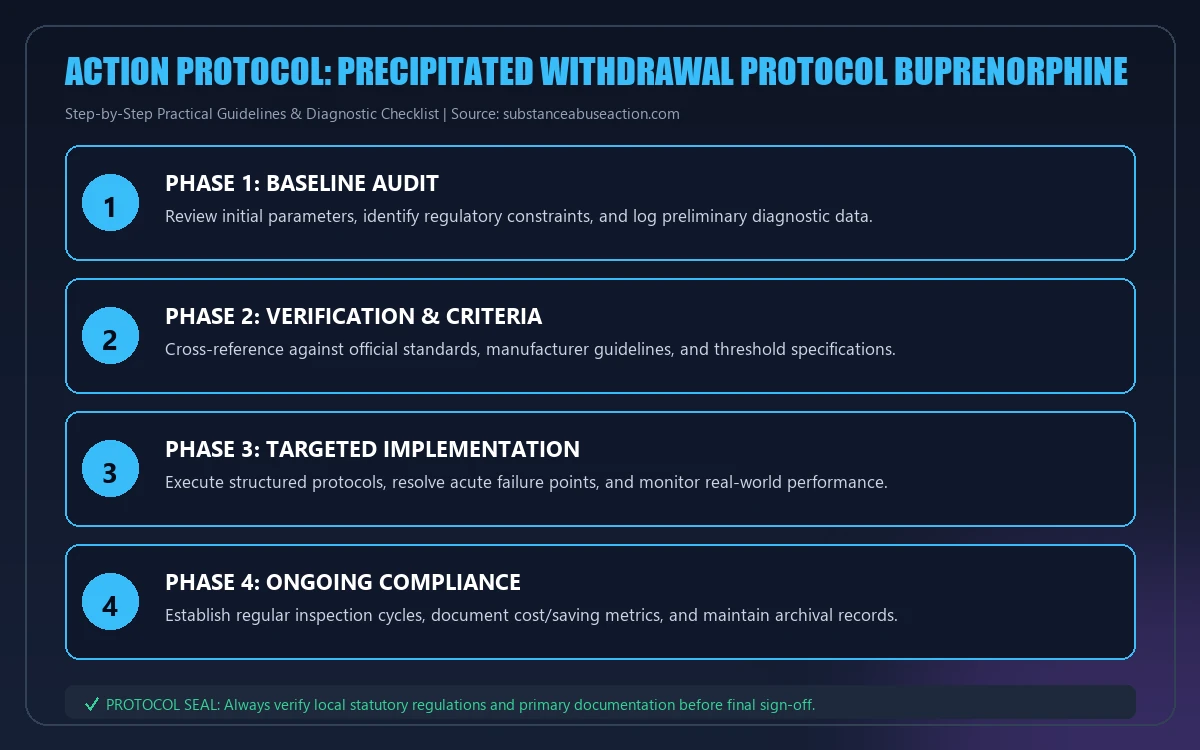
The following sequence applies when COWS score rises above 13 within 60 minutes of initial buprenorphine administration, confirming iatrogenic displacement rather than background withdrawal progression:
- Obtain baseline COWS score and vital signs immediately. Confirm symptom onset within 15 to 45 minutes of sublingual buprenorphine administration, with pupil dilation, piloerection, tachypnea, and diaphoresis present.
- Establish continuous pulse oximetry, cardiac telemetry, and end-tidal capnography before any rescue dosing.
- Administer buprenorphine 8 to 16 mg sublingual as first rescue dose. Do not discontinue medication.
- Administer adjunctive autonomic suppression: lofexidine per FDA-approved labeling (0.54 mg per tablet, recommended dose three tablets [1.62 mg] up to four times daily as tolerated, subject to QTc and blood pressure monitoring with baseline ECG required before administration; lofexidine is contraindicated in QTc prolongation, bradycardia, and hypotension) or clonidine 0.2 to 0.3 mg orally, combined with ondansetron 4 to 8 mg IV for acute emesis control.
- Reassess COWS at 45 to 60 minutes. If score remains above 8 or patient reports severe distress, administer second buprenorphine rescue dose of 8 to 16 mg sublingual, targeting cumulative total of 24 to 32 mg within a two-hour window.
- If COWS remains above 8 after cumulative 32 mg and autonomic instability persists, initiate secondary adjuvant sedation with lorazepam 1 to 2 mg IV under physician supervision, or escalate to inpatient full-agonist rescue protocol with medical toxicologist involvement.
- Maintain observation until COWS falls below 5 and remains stable for two consecutive hours before assessing discharge eligibility.
The 58.seven-day retention rate observed by D’Onofrio et al. (2023) in the multicenter high-dose cohort reflects the downstream benefit of completing this precipitated withdrawal protocol buprenorphine sequence: patients who leave the ED with acute distress terminated are substantially more likely to engage in ongoing MOUD care than those who leave in crisis.
Inpatient Full-Agonist Rescue: Indications, Risks, and Infrastructure Requirements
This section describes a protocol appropriate only for monitored inpatient or resuscitation settings. It must not be applied in outpatient, urgent care, or unmonitored environments.
When cumulative buprenorphine dosing to 32 mg fails to resolve precipitated withdrawal, inpatient full-agonist rescue via mass-action displacement becomes a clinical option under medical toxicology supervision. Buprenorphine’s sub-nanomolar affinity is high but not absolute; thermodynamic mass-action principles allow sufficiently concentrated full agonists to compete at the binding pocket when administered in controlled, titrated increments.
In monitored resuscitation settings with continuous capnography, suction, bag-valve mask, and IV naloxone immediately available, clinicians may administer IV fentanyl in small, carefully titrated increments starting at 25 to 50 mcg, reassessing respiratory status and autonomic parameters between each dose under direct physician supervision. Any IV opioid titration in a buprenorphine-occupied patient requires individualized dosing guided by real-time monitoring, not a fixed bolus schedule.
The 2020 ASAM National Practice Guideline, per Journal of Addiction Medicine, establishes the foundational clinical branch point between supportive cessation and continued buprenorphine titration in precipitated withdrawal management. High-dose escalation protocols reaching 24 to 32 mg and IV agonist rescue strategies emerged from post-2021 emergency department literature, specifically Herring 2021 and D’Onofrio 2023; the 2020 ASAM guideline should not be cited as the source of those specific dosing thresholds.
Re-initiating buprenorphine after full-agonist rescue requires waiting for illicit fentanyl metabolite clearance and then employing micro-induction overlap techniques rather than standard macro-induction.
Outpatient Prevention: Precipitated Withdrawal Protocol Buprenorphine via Micro-Induction
Patients with recent, heavy illicit fentanyl exposure represent the population at highest risk for buprenorphine induction crisis, because peripheral fentanyl stores leak continuously into plasma and maintain erratic receptor equilibrium that standard COWS-guided induction thresholds cannot reliably detect. Micro-induction, sometimes called the Bernese method, prevents precipitated withdrawal by introducing buprenorphine in doses too small to displace meaningful full-agonist receptor occupancy while full agonists remain active, allowing gradual co-occupation of mu-receptors across several days.
Multiple published Bernese method protocols exist with materially different titration schedules. Hämmig et al. described one of the earliest formalized outpatient micro-induction approaches, and subsequent adaptations by Becker et al. and others have varied starting doses, escalation intervals, and full-agonist cessation timing based on patient opioid burden and clinical setting. One commonly referenced outpatient schedule begins at 0.5 mg sublingual on day one, advances to 0.5 mg twice daily on day two, 1 mg twice daily on day three, 2 mg twice daily on day four, 4 mg twice daily on day five, 8 mg on day six, and reaches 16 mg daily maintenance on day seven with concurrent full-agonist cessation. Clinicians selecting a precipitated withdrawal protocol buprenorphine micro-induction schedule should consult published protocol literature and institutional addiction medicine guidance rather than treating any single schedule as universally standardized, since titration speed must be individualized to opioid burden and patient tolerance.
Gradual accumulation displaces full agonists imperceptibly across seven to ten days, preserving baseline receptor tone throughout. Patients maintain daily function during transition, avoiding the visceral iatrogenic trauma that drives avoidance of future MOUD engagement.
Institutional Governance and Documentation Standards
Facilities managing buprenorphine induction crisis require codified order sets within electronic medical record systems that permit immediate rescue dose escalation under physician supervision without bureaucratic delay. Pre-approved clinical pathways for 8 to 16 mg buprenorphine re-administration following confirmed precipitated withdrawal reduce the interval between symptom onset and pharmacological intervention, which directly affects whether patients remain in the clinical setting long enough to stabilize.
Documentation must capture serial COWS scores with timestamps, vital signs at each assessment interval, exact doses administered with administration times, adjunctive medications given, and the clinical rationale for each escalation decision. This record establishes adherence to contemporary addiction medicine standards and demonstrates proactive management of a known pharmacodynamic induction risk. Facilities that have embedded precipitated withdrawal protocol buprenorphine rescue pathways into standing order sets report substantially lower rates of against-medical-advice departure during induction crises, consistent with the retention signal observed in the D’Onofrio 2023 multicenter cohort.
Frequently Asked Questions
What triggers precipitated withdrawal during buprenorphine induction, and why does it happen faster with fentanyl-exposed patients?
Precipitated withdrawal occurs when buprenorphine’s high mu-receptor affinity displaces a full agonist faster than its partial-agonist intrinsic efficacy can compensate for the lost signal. Fentanyl-exposed patients are disproportionately vulnerable because illicit fentanyl’s extreme lipophilicity creates large peripheral tissue reservoirs that continue releasing drug into plasma long after last use, meaning residual receptor occupancy may be far higher than COWS score alone suggests at the time of induction. Standard COWS thresholds were validated in heroin-era populations; they systematically underestimate fentanyl receptor burden, which is why even patients scoring below 12 on COWS can experience severe precipitated withdrawal within minutes of a first sublingual dose.
How does receptor saturation titration resolve an induction crisis without causing respiratory depression?
Buprenorphine’s ceiling effect on respiratory depression is pharmacologically distinct from its ceiling on withdrawal suppression. At cumulative doses up to 32 mg, receptor occupancy rises toward 85 to 90%, generating sufficient net mu-receptor signaling to suppress locus coeruleus hyperactivity, while the partial-agonist ceiling on respiratory drive limits apnea risk that would accompany equivalent full-agonist dosing. Herring et al. (2021) observed zero cases of respiratory depression attributable to buprenorphine across 579 high-dose ED encounters, and the 58.seven-day retention rate in D’Onofrio et al. (2023) confirms that completing escalation rather than abandoning it produces durable downstream engagement in MOUD care.
When should lofexidine be chosen over clonidine as adjunctive autonomic support?
Lofexidine’s alpha-2A selectivity produces less hypotension than clonidine, making it preferable when blood pressure is already borderline or when outpatient transition is planned, since clonidine’s hypotensive burden complicates discharge planning. Lofexidine carries a black box warning for QT prolongation and requires baseline ECG screening before administration; patients with QTc above 450 ms, concurrent QT-prolonging medications, or bradycardia should receive clonidine instead, with careful blood pressure monitoring throughout. FDA-approved lofexidine dosing is 0.54 mg per tablet with a recommended dose of three tablets (1.62 mg) up to four times daily — a single 0.54 mg tablet does not constitute a therapeutic rescue dose and should not be administered as one.
What distinguishes high-dose buprenorphine rescue from standard opioid withdrawal management in terms of mechanism and urgency?
Standard opioid withdrawal management addresses spontaneous agonist clearance, a gradual process unfolding over hours to days as drug elimination proceeds naturally. Buprenorphine induction crisis is iatrogenic and acute: high-affinity displacement creates an abrupt receptor signaling deficit within minutes, and the displaced full agonist cannot rebind because buprenorphine occupies the site with sub-nanomolar affinity. Supportive measures that suffice for spontaneous withdrawal, such as clonidine and antiemetics alone, cannot close the mu-receptor agonism gap that drives precipitated withdrawal. Executing a structured precipitated withdrawal protocol buprenorphine escalation to 24 to 32 mg is the only pharmacological intervention that addresses the primary molecular deficit without requiring full-agonist rescue infrastructure.
References
- Herring, A. A., Vosooghi, A. A., Luftig, J., Anderson, E. S., Zhao, X., Dziura, J., Hawk, K. F., McCormack, R. P., Watson, D. P., & D’Onofrio, G. (2021). High-Dose Buprenorphine Induction in the Emergency Department for Treatment of Opioid Use Disorder. Annals of Emergency Medicine, 78(1), 83–91. https://pubmed.ncbi.nlm.nih.gov/34274191/
- Food and Drug Administration. (2021). Suboxone (buprenorphine and naloxone) Sublingual Film prescribing information (Reference ID: 4744042). U.S. Department of Health and Human Services. https://www.accessdata.fda.gov/drugsatfda_docs/label/2021/022410s042lbl.pdf
- D’Onofrio, G., Hawk, K. F., Perrone, J., Venkatesh, A. K., Hunt, D. M., & Herring, A. A. (2023). Multicenter Evaluation of High-Dose Buprenorphine Induction in Emergency Departments for Opioid Use Disorder. JAMA Network Open, 6(6), e2318712. https://pubmed.ncbi.nlm.nih.gov/37384346/
- American Society of Addiction Medicine. (2020). The ASAM National Practice Guideline for the Treatment of Opioid Use Disorder: 2020 Focused Update. Journal of Addiction Medicine, 14(2S), 1–91. https://pubmed.ncbi.nlm.nih.gov/32511106/
- Gorodetzky, C. W., Walsh, S. L., Martin, P. R., Saxon, A. J., Gullo, S. V., & Biswas, K. (2017). A phase III, randomized, multi-center, double-blind, placebo-controlled study of safety and efficacy of lofexidine for relief of symptoms in individuals undergoing inpatient opioid withdrawal. Drug and Alcohol Dependence, 176, 79–88. https://pubmed.ncbi.nlm.nih.gov/28623748/