Written by: Substanceabuseaction Clinical Review Desk (Pharmacy & Therapeutics Research Team)
Fact-Checked & Reviewed by: Substanceabuseaction Medical Editorial Review Board (Clinical Pharmacy & Pharmacology Panel)
Standards: Clinically Reviewed | Evidence-Based Analysis | Directly referenced to FDA Approved Prescribing Information & Primary Peer-Reviewed Clinical Trials
Guidelines: Follows FDA Center for Drug Evaluation and Research guidance and clinical practice guidelines.
Clinical Pharmacotherapy Standard: Missed-dose thresholds and titration parameters directly cross-reference official FDA Prescribing Information labels and clinical pharmacology practice considerations.
Precipitated withdrawal represents severe iatrogenic crisis triggered when partial opioid agonists displace full agonists from mu-opioid receptors without delivering equivalent intracellular signal transduction. Emergency clinicians activating modern precipitated withdrawal protocol pathways must abandon historical cessation tactics. Halting buprenorphine administration leaves patients stranded in profound receptor vacancy deficits. Rapid clinical stabilization demands immediate high-dose partial agonist escalation. Executing structured precipitated withdrawal protocol maneuvers achieves rapid receptor saturation, driving net intrinsic activity back toward tolerable homeostatic baselines within sixty to ninety minutes.
Physiologic distress requires swift intervention. While conventional guidelines historically recommended supportive care or reinstitution of full opioid agonists, contemporary emergency practice relies on rapid high-dose rescue titration to flood central mu-opioid receptors, effectively converting catastrophic receptor displacement into sustained partial agonist maintenance.
Neurobiology Underlying Precipitated Withdrawal Protocol Titration
Receptor dynamics dictate clinical recovery. Understanding these cellular interactions demands precise evaluation of mu-opioid receptor binding affinity (Ki) alongside intrinsic post-receptor signaling efficacy across diverse chemical classes.
+-----------------------------------------------------------------------------------+
|               MU-OPIOID RECEPTOR DISPLACEMENT & SATURATION MECHANISM               |
+-----------------------------------------------------------------------------------+
| Baseline State:                                                                   |
| [Full Agonist (Fentanyl)] ---> Bound to Mu-Receptor ---> High Intrinsic Signal     |
|                                                                                   |
| Traditional Low-Dose Error (Precipitated Withdrawal):                             |
| [Low-Dose Buprenorphine (2-4mg)] ---> High Affinity Displaces Full Agonist        |
|                                  ---> Only 30-40% Receptor Saturation              |
|                                  ---> NET INTRINSIC EFFICACY DEFICIT (Agony)      |
|                                                                                   |
| Modern 2025 High-Dose Rescue Protocol:                                           |
| [Rescue Buprenorphine (16-32mg)] ---> High Affinity Displaces Full Agonist        |
|                                  ---> 85-95% Complete Receptor Saturation         |
|                                  ---> Intrinsic Signal Ceiling Reached (Relief)   |
+-----------------------------------------------------------------------------------+
Buprenorphine exhibits sub-nanomolar mu-opioid receptor binding affinity (Ki), ranging between 0.21 and 0.24 nM. This binding affinity dwarfs that of morphine (Ki approximately 1.0 to 2.0 nM) and fentanyl (Ki approximately 1.2 to 1.4 nM). When buprenorphine enters systemic circulation, its superior affinity strips residual full agonists from receptor active sites almost instantaneously.
Displacement creates acute signal collapse. While full agonists stimulate maximal intracellular G-protein activation, buprenorphine functions with intrinsic efficacy deficit, producing roughly 30% to 40% of maximal G-protein coupling response. When small initial buprenorphine dose (2mg to 4mg) displaces full agonist, buprenorphine binds insufficient total receptor fractions, stripping high-efficacy agonist while leaving 60% to 70% of remaining mu receptors unoccupied.
Total downstream cyclic adenosine monophosphate (cAMP) suppression implodes. Severe autonomic rebound erupts as noradrenergic locus coeruleus neurons fire without inhibition. Detailed pharmacodynamic specifications established within FDA Suboxone prescribing information on precipitated withdrawal pharmacology confirm buprenorphine dissociation half-life exceeds 166 minutes, locking molecules onto receptors and preventing displaced full agonists from re-attaching. Understanding this cellular dynamic guides contemporary precipitated withdrawal protocol design.
Under-dosing creates maximum physiologic agony. If clinicians administer merely 2mg or 4mg sublingually, resulting net receptor activation falls below physiological thresholds required to prevent acute withdrawal shock. Patient remains trapped with neither full agonist signaling nor adequate partial agonist receptor occupancy.
The Under-Dosing Trap and High-Dose Rescue Mechanics
Clinical instincts often mislead providers. When patient screams in agony forty minutes after initial buprenorphine administration, bedside providers instinctively withhold further medication, believing additional partial agonist will worsen autonomic destabilization. Halting administration during acute crisis drives standard precipitated withdrawal protocol failure across community facilities.
Stopping medication strands uncoupled receptors. Because buprenorphine dissociation takes hours, withholding doses guarantees patient endures prolonged agony while intracellular signal transmission stays depressed below tolerable homeostatic thresholds. Published high-dose buprenorphine rescue titration evidence confirms administering rapid supplemental doses of 8mg to 16mg sublingual buprenorphine (escalating cumulative doses to 24mg or 32mg within two to four hours) achieves near-complete mu-receptor occupancy, canceling acute signaling deficits within 60 to 120 minutes.
Receptor saturation restores autonomic stability. By forcing buprenorphine occupancy across 85% to 95% of available central mu-opioid receptors, partial agonist ceiling effect compensates for low intrinsic efficacy through sheer volumetric activation. This clinical pharmacology proves why modern precipitated withdrawal protocol shifts therapeutic logic toward aggressive agonist saturation.
Specialist precipitated withdrawal protocol reverses this pharmacologic trap by overriding receptor vacancy. Rather than allowing patient to suffer prolonged distress or abandon treatment, rapid titration protocol floods central nervous system synapses, driving net opioid tone back to baseline stability.
Emergency High-Dose Precipitated Withdrawal Protocol Architecture
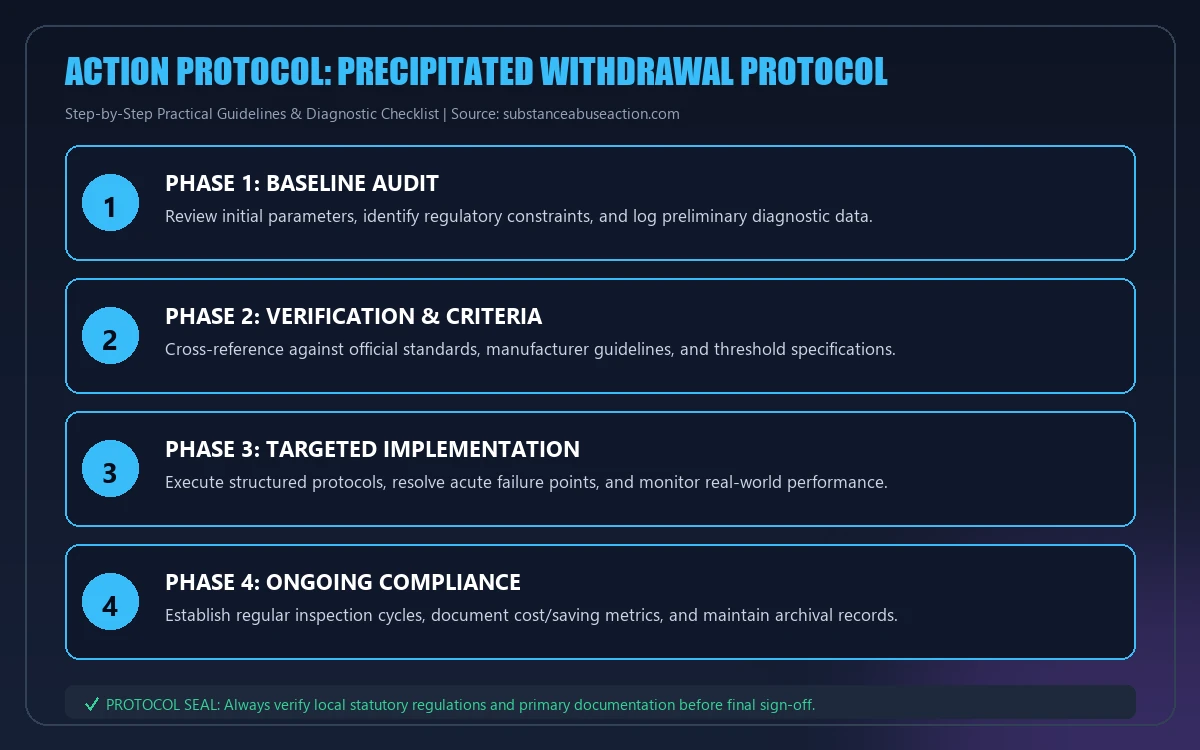
Emergency stabilization requires structured action. The following ordered clinical algorithm outlines immediate interventions mandated during acute precipitated withdrawal events.
Step 1: Rapid Objective Severity Stratification
Immediately calculate Clinical Opiate Withdrawal Scale (COWS) score upon patient decompensation. Do not rely on subjective patient complaints alone; document objective signs:
- Resting pulse rate exceeding 100 beats per minute
- Pronounced diaphoresis and diffuse piloerection
- Objective gastrointestinal hypermotility (vomiting or diarrhea)
- Marked pupillary dilation (mydriasis >= 5 mm)
- Visible tremors and severe joint arthralgias
If score shifts upward by 6 or more points from baseline, or reaches absolute score >= 13 within 15 to 45 minutes following buprenorphine administration, immediately confirm diagnosis of iatrogenic precipitated withdrawal.
Step 2: Immediate Rescue Dosing Administration
Initiate emergency precipitated withdrawal protocol dosing immediately upon symptom emergence:
- Administer buprenorphine 8mg sublingual tablet or film without delay.
- For extreme autonomic presentations (COWS score >= 20, profuse emesis, marked tachycardia), administer 16mg sublingually as single initial rescue bolus.
- Instruct patient to retain sublingual medication under tongue for minimum eight minutes; avoid swallowing saliva prematurely to preserve systemic bioavailability.
Step 3: Targeted Ancillary Pharmacotherapy Integration
Simultaneously administer parenteral or sublingual symptom-targeted adjuncts while rescue buprenorphine undergoes systemic absorption:
- Autonomic hyperactivity: Clonidine 0.1mg to 0.2mg orally or intramuscularly every 60 minutes (hold if systolic blood pressure falls below 90 mmHg or heart rate drops under 55 beats per minute). Alternative: Lofexidine 0.54mg orally every four hours.
- Severe emesis: Ondansetron 4mg to 8mg intravenously or orally disintegrating tablet every eight hours. Add prochlorperazine 10mg intravenously if vomiting persists.
- Musculoskeletal arthralgia and cramping: Ketorolac 15mg to 30mg intravenously every six hours, provided renal function remains intact and active gastrointestinal bleeding is absent.
- Agitation and anxiety: Diphenhydramine 25mg to 50mg intravenously or lorazepam 1mg to 2mg intravenously under continuous telemetry monitoring if muscle rigidity or panic dominates presentation.
Step 4: Serial Monitoring and Second-Tier Dose Escalation
Re-evaluate patient exactly 45 to 60 minutes after initial rescue dose administration:
- Re-calculate formal COWS score.
- If COWS score remains >= 10, or clinical distress fails to demonstrate downward trajectory, administer second rescue dose of buprenorphine 8mg to 16mg sublingually.
- Target cumulative buprenorphine dose across acute stabilization window: 24mg to 32mg total.
- Maintain intravenous crystalloid hydration (normal saline or lactated Ringer’s solution at 150 to 250 mL/hour) to correct fluid deficits resulting from diaphoresis and gastrointestinal losses.
Rigorous evaluation confirms protocol safety. Emergency department data published in emergency department high-dose buprenorphine induction safety data documented 366 high-dose induction encounters (doses >=12mg escalating to 32mg), revealing precipitated withdrawal occurred in only 0.5% of cases, with all identified cases resolving completely following supplemental 8mg to 16mg buprenorphine administration.
Overall clinical success within this precipitated withdrawal protocol depends on overcoming provider hesitation during peak autonomic distress. Clinicians must recognize that escalating buprenorphine to ceiling occupancy levels resolves distress without provoking respiratory depression. Continuous physiologic monitoring requirements during precipitated withdrawal protocol execution mandate tracking capnography, oxygen saturation, and cardiac rhythm until COWS scores descend below 5 for two consecutive hours.
Fentanyl Precipitated Withdrawal and Adipokinetic Clearance
Illicit fentanyl complicates standard practice. Unlike short-acting pharmaceutical opioids like morphine or hydromorphone, synthetic fentanyl analogs present extreme lipophilicity (octanol-water partition coefficient logP of 4.05, compared to 0.90 for morphine). Fentanyl rapidly crosses blood-brain barrier before redistributing into peripheral skeletal muscle and deep adipose tissue reserves.
Adipokinetic fentanyl clearance creates persistent systemic exposure. During chronic illicit usage, deep adipose reservoirs saturate completely. Following abrupt cessation, fentanyl slowly leaches from fat compartments back into vascular circulation, demonstrating terminal elimination half-lives exceeding 48 to 120 hours. Patients frequently test positive for parent fentanyl and norfentanyl via mass spectrometry five to twenty days after last active consumption.
Adipose reservoir clearance complicates standard precipitated withdrawal protocol execution when urine toxicology remains positive for weeks. Traditional waiting periods of 12 to 24 hours prove wholly inadequate for fentanyl-exposed individuals. When buprenorphine is introduced based solely on elapsed time, massive receptor displacement occurs because baseline mu-opioid sites remain loaded with lingering lipophilic fentanyl, despite absent acute subjective intoxication.
+-------------------------------------------------------------------------------+
|             FENTANYL LIPID ACCUMULATION VS. MORPHINE PHARMACOKINETICS         |
+-------------------------------------------------------------------------------+
| Property                      Morphine              Fentanyl                  |
+-------------------------------------------------------------------------------+
| Lipophilicity (logP)          0.90 (Low)            4.05 (Extreme)            |
| Primary Elimination Phase     Renal excretion       Adipose tissue storage    |
| Terminal Half-Life            2 to 3 hours          48 to 120+ hours          |
| Washout Window Required       12 to 18 hours        Variable (24 to 72 hours) |
| Precipitated Reaction Risk    Moderate              Severe / Protracted       |
| Primary Rescue Strategy       Standard 8mg titration High-dose (24-32mg)      |
+-------------------------------------------------------------------------------+
Lipid storage requires aggressive titration. Treating synthetic opioid dependence requires tailored precipitated withdrawal protocol parameters that account for erratic lipid redistribution. When fentanyl precipitated withdrawal hits, clinical team cannot rely on passive elimination; aggressive buprenorphine rescue titration must force high-affinity partial agonist occupancy to overcome unpredictable systemic trickling of endogenous fentanyl stores.
Applying high dose buprenorphine induction strategies early in clinical encounters drastically reduces net vulnerability windows. By accelerating buprenorphine ramp-up to >=16mg during initial presentation, clinicians overcome adipose-clearing full agonist competition, securing receptor pathways before withdrawal cascade amplifies.
Alternative Pathways: Bernese Method Buprenorphine and Micro-Induction
Prevention represents ideal care. When emergency or ambulatory patients cannot tolerate required abstinence windows due to fears of fentanyl precipitated withdrawal, micro-dosing protocols bypass withdrawal requirements entirely.
Bernese method buprenorphine protocols utilize slow, incremental partial agonist accumulation. Because buprenorphine possesses ultra-high binding affinity, micro-doses (0.2mg to 0.5mg) bind minimal fractions of available mu receptors without dislodging bulk full agonist signaling. Patient continues consuming full agonist (prescribed full agonist or street fentanyl) at standard maintenance levels while buprenorphine slowly accumulates in central nervous system compartments.
+-----------------------------------------------------------------------------------+
|               BERNESE METHOD MICRO-INDUCTION TITRATION SCHEDULE                   |
+-----------------------------------------------------------------------------------+
| Day 1: 0.5mg sublingual once daily    | Continue full baseline opioid agonist     |
| Day 2: 0.5mg sublingual twice daily   | Continue full baseline opioid agonist     |
| Day 3: 1.0mg sublingual twice daily   | Continue full baseline opioid agonist     |
| Day 4: 2.0mg sublingual twice daily   | Continue full baseline opioid agonist     |
| Day 5: 4.0mg sublingual twice daily   | Continue full baseline opioid agonist     |
| Day 6: 8.0mg sublingual once daily    | Continue full baseline opioid agonist     |
| Day 7: 12.0mg sublingual total dose   | Taper full baseline opioid agonist        |
| Day 8: 16.0mg sublingual maintenance  | DISCONTINUE FULL AGONIST COMPLETELY       |
+-----------------------------------------------------------------------------------+
Micro-dosing protects cellular equilibrium. Clinicians utilize this alternative preventive precipitated withdrawal protocol to bypass acute abstinence requirements in outpatient settings. Over seven to ten days, buprenorphine steadily occupies expanding receptor percentages while full agonist molecules are gently edged out without triggering acute signaling collapses. On day seven or eight, when buprenorphine cumulative dose reaches 12mg to 16mg, full agonist is abruptly discontinued with zero precipitated withdrawal symptoms.
Expanding outpatient access accelerates ambulatory precipitated withdrawal protocol adoption among individuals unable to tolerate traditional induction abstinence. While Bernese method buprenorphine eliminates precipitated withdrawal risk, its primary limitation remains execution timeline: outpatient micro-induction requires continuous compliance across seven to ten days, rendering it ill-suited for volatile emergency department encounters demanding immediate stabilization.
Comparative Analysis of Buprenorphine Initiation Pathways
Clinical pathways diverge across operational parameters. Systematic evaluation of each precipitated withdrawal protocol reveals marked operational divergences in clinical settings.
| Protocol Modality | Target Patient Population | Induction Preconditions | Escalation Window | Acute Precipitation Risk | Rescue Capacity Requirement |
|---|---|---|---|---|---|
| Traditional Low-Dose Induction | Short-acting prescription opioid users | Strict abstinence; COWS >= 12–14 | 2mg to 4mg increments over 12–24 hours | Elevated in illicit fentanyl exposure (9%–14%) | High; frequently leaves uncoupled receptor deficit |
| High-Dose ED Induction Protocol | Illicit fentanyl and long-acting synthetic users | Moderate withdrawal; COWS >= 8–10 | 8mg to 16mg bolus, escalating rapidly to 24mg–32mg | Extremely low (<= 0.5% in monitored trials) | Low; protocol intrinsically incorporates self-rescue saturation |
| Bernese Method Micro-Induction | Ambulatory patients, perioperative patients, fearful chronic users | Zero abstinence; patient continues full agonist | 0.2mg–0.5mg micro-doses titrating over 7–10 days | Near zero (< 0.2%) | Low; preserves baseline signaling throughout transition |
| Rapid High-Dose Rescue Titration | Active iatrogenic precipitated withdrawal crisis | Immediate onset of severe distress; COWS spike >= 6 | 8mg to 16mg immediate rescue, escalating to 32mg within 2 hours | N/A (Administered strictly to terminate active crisis) | High; represents primary emergency pharmacological rescue |
Large-scale clinical trial findings corroborate high-dose efficacy. Findings from randomized clinical trial on high-dose buprenorphine protocol outcomes demonstrated high-dose escalation to >=16mg produced <=0.5% precipitated withdrawal rate across active arms, achieved 48.30-day treatment retention, and resulted in zero cases of respiratory depression or acute sedation compared to historical low-dose titration controls. Trial outcomes demonstrate overall precipitated withdrawal protocol efficacy when clinicians titrate to adequate receptor saturation.
Regulatory Standards and Statutory Frameworks
Statutory revisions dismantle historic prescribing barriers. Federal deregulation has fundamentally reorganized how hospitals, acute care facilities, and office-based addiction medicine practices manage induction complications.
Under updated SAMHSA rules, clinician executing precipitated withdrawal protocol retains authority to titrate beyond outdated daily limits. The Department of Health and Human Services and SAMHSA published their comprehensive final rule (89 FR 7528) revising Opioid Treatment Program regulations under SAMHSA 42 CFR Part 8 opioid treatment standards. This landmark statutory update eliminates rigid waiting intervals, establishes direct provider titration autonomy, authorizes split-dosing regimens, validates micro-induction overlapping strategies, and removes arbitrary single-day dose ceilings that historically restricted emergency buprenorphine dosing to 16mg or 24mg.
Federal statutory protection ensures precipitated withdrawal protocol deployment without fear of DEA disciplinary action for aggressive titration. Emergency departments, operating under Emergency Medical Treatment and Labor Act (EMTALA) mandates, must provide stabilizing treatment for acute substance-induced physical distress. Because precipitated withdrawal constitutes severe iatrogenic condition, immediate titration of buprenorphine up to 32mg daily falls squarely within protected medical stabilization mandates.
Emergency departments must update institutional precipitated withdrawal protocol compliance manuals to reflect these deregulation milestones. Clinical directives restricting daily initial buprenorphine exposure to 8mg or 12mg are medically obsolete and legally unnecessary. Hospital medicine networks benefit by adopting verified precipitated withdrawal protocol pathways that match current administrative codes.
Frequently Asked Questions
How rapidly does an emergency precipitated withdrawal protocol resolve acute symptoms?
Emergency rescue protocol utilizing rapid high-dose sublingual buprenorphine titration typically produces measurable symptom improvement within 45 to 60 minutes following first supplemental 8mg or 16mg dose. Complete resolution of autonomic crisis and descent of COWS scores to mild baseline levels (< 5) occurs within 90 to 120 minutes as cumulative doses reach 24mg to 32mg, forcing partial agonist receptor occupancy above eighty-five percent.
What clinical timeline governs the Bernese method buprenorphine transition schedule?
Bernese micro-induction titration schedule spans seven to ten days. Initial phase administers micro-doses starting at 0.5mg once daily on day one, ramping to 0.5mg twice daily on day two, 1mg twice daily on day three, and progressively doubling through day six while patient continues baseline illicit or prescribed full agonist opioids. Full agonist consumption ceases completely on day seven or eight once buprenorphine dosing reaches 12mg to 16mg daily, ensuring smooth receptor handoff without withdrawal.
Why does fentanyl precipitated withdrawal require cumulative buprenorphine doses exceeding twenty-four milligrams?
Synthetic fentanyl accumulates extensively within lipid compartments, creating continuous systemic back-leakage that competes with buprenorphine at mu-opioid receptor sites long after consumption stops. Cumulative doses reaching 24mg to 32mg are required to achieve pharmacodynamic receptor saturation, driving net intracellular G-protein signaling past the therapeutic threshold required to offset intrinsic efficacy deficits caused by displacement of potent synthetic full agonists.
When should clinicians initiate emergency rescue medication based on the Clinical Opiate Withdrawal Scale?
Emergency rescue titration should begin immediately when a patient experiences an acute score increase of 6 or more points, or crosses absolute threshold of COWS >= 13, within two hours of receiving initial buprenorphine. Clinicians should not delay rescue titration awaiting further clinical deterioration; immediate intervention with 8mg to 16mg sublingual buprenorphine halts progressive neuroautonomic collapse.
Clinical Takeaway and Future Directives
Reversing iatrogenic withdrawal demands aggressive pharmacology. Clinical mastery of modern precipitated withdrawal protocol eliminates patient suffering during vulnerable care transitions. When partial agonists displace lipophilic full agonists, withholding medication locks mu receptors in devastating signaling voids.
Clinicians must push past historic prescribing hesitations. Administering rapid supplemental buprenorphine boluses up to 32mg cumulative daily thresholds saturates central receptors, triggers partial agonist ceiling protections, and restores physiologic homeostasis. Expanding standardized precipitated withdrawal protocol utilization across emergency networks prevents unnecessary intensive care admissions. Future addiction medicine depends on robust precipitated withdrawal protocol execution to dismantle systemic treatment barriers.
References
- Herring AA, Vosooghi AA, Luftig J, et al. High-Dose Buprenorphine Induction in the Emergency Department for Treatment of Opioid Use Disorder. JAMA Network Open. 2021;4(7):e2117128. doi:10.1001/jamanetworkopen.2021.17128. Available from: https://pubmed.ncbi.nlm.nih.gov/34264485/
- US Food and Drug Administration. Suboxone (buprenorphine and naloxone) Sublingual Film NDA 022410 Prescribing Information. Silver Spring, MD: FDA Center for Drug Evaluation and Research; 2022. Available from: https://www.accessdata.fda.gov/drugsatfda_docs/label/2022/022410s046lbl.pdf
- D’Onofrio G, Hawk KF, Perrone J, et al. High-Dose Buprenorphine Initiation in the Emergency Department: A Randomized Clinical Trial. JAMA. 2023;330(16):1540-1549. doi:10.1001/jama.2023.19777. Available from: https://pubmed.ncbi.nlm.nih.gov/37815563/
- Substance Abuse and Mental Health Services Administration. Medications for the Treatment of Opioid Use Disorder; Final Rule, 42 CFR Part 8 (89 FR 7528). Federal Register. 2024;89(23):7528-7585. Available from: https://www.federalregister.gov/documents/2024/02/02/2024-01693/medications-for-the-treatment-of-opioid-use-disorder
- Quattlebaum T, Bogan M, Stone M, et al. High-Dose Buprenorphine Titration for the Treatment of Precipitated Opioid Withdrawal: A Case Series and Pharmacokinetic Review. Journal of Addiction Medicine. 2021;15(4):340-345. doi:10.1097/ADM.0000000000000732. Available from: https://pubmed.ncbi.nlm.nih.gov/33022513/